FAQs

Frequently Asked Questions

How hard is sailing?

Sailing competence develops through structured learning, practice, and experience. With proper preparation and instruction, sailing becomes an achievable and rewarding skill.
https://sailing-blog.nauticed.org/how-hard-is-sailing-really/

The following is a list of items that you should bring with you to your class. In addition to physical items, please have all your textbook reading completed before the first day of class.

Please be ready to go at 9:00 am. on the first day. PLEASE BE PROMPT!!!!

Items for all Courses
  • Appropriate clothing for the weather. Please do not wear jeans with rivets, as they scratch the boat. On the bay, the weather can vary greatly. We recommend dressing in layers. A good waterproof windbreaker is a good idea. Foul weather gear is not necessary at this level, but is a good investment should you choose to purchase it. West Marine is a good source for quality sailing gear, and there’s a store near us here in Point Richmond.
    • Boat shoes–non-skid and no black soles
    • Sunglasses
    • Hat with tether
    • Sunscreen
    • Sailing gloves
      (We generally have West Marine sailing gloves for sale at our office.)
  • Personal Flotation Devices are provided, but we encourage you to use your own if you have one. (We generally have inflatable PFDs for sale at our office at a discount to students).
  • Lunches: Please bring your lunch with you! You may have the opportunuty to eat on board at anchor, at a dock, or back at the club house.
Large and small keel boat courses

In addition, please bring:

  • Please bring work gloves for muddy anchoring.

Bareboat Chartering

bring your lunch for day one. The class will plan subsequent meals based on eating aboard and / or visiting local restaurants.
It is often cool and wet during the night and early morning, so be ready for that.

  • As this is an overnight trip, please bring a sleeping bag, toiletries, a change of clothes and any other necessities, such as prescription medication.
  • Dinner and breakfast will be shared with the other students.
  • Alcohol is only permitted after the boat is secured for the evening.

No. We provide US Coast Guard approved Personal Flotation Devices to all of our students. We have correct sizes for people of all ages, including juniors. We insist that our students wear a PFD while participating in our programs. However, you are welcome to bring your own lifejacket if it is US Coast Guard approved.

No. When you first take your lessons, wear normal outdoor clothing. As well, bring running shoes and a hat. Bring a few extra clothes as the temperature can be cooler on the water. When you sign up for one of our courses, we send you complete course instructions. When you are sailing on a regular basis after completing your lessons, you may choose to purchase some sailing clothes – eg. foul weather gear.

How do we teach our classes?

First of all, we spend as much time on the water as possible. We begin each day with a short lecture on theory, knot tying, or Coast Guard rules to ensure that our students are prepared to execute the practical requirements on the water.

Students are expected to have completed all of the assigned textbook reading prior to the first day of the course. If all students adhere to this requirement, then even less time is spent on land.

Then it’s out of the slip for practical application. The instructor demonstrates the procedure and then it’s the student’s turn.

Students alternate as either crew or helmsman for each procedure. Back in the slip, we have a critique of the day’s activities and plan for any areas that require additional work. We don’t believe doing something once is enough. We stress repetition to reinforce what the student has leaned.

Our instructors only act as helmsman or crew to demonstrate procedures, the majority of the time, the students are handling the yacht.

Our Sailing School method allows students to learn the roles and responsibilities of both helmsman and crew and develop their skills working as a team. When a student is acting as helmsman, he is responsible for organizing and commanding the crew. Proper and clear communication skills are an important part of this position.

Our class size limit of 3 (most courses) to 4 students allows plenty of practice time.
Your success in completing your next course level depends greatly on the amount practice that you do in between each course. We recommend that you practice on various boats. Practicing increases your confidence and the diversity of your skills.

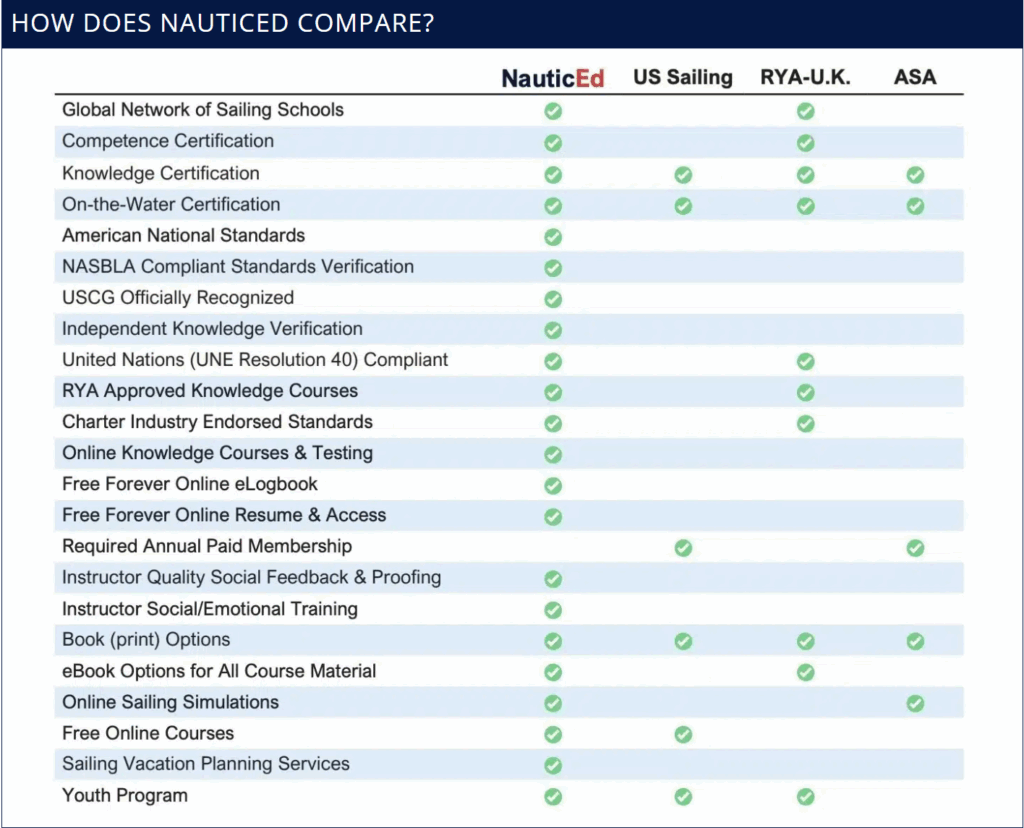
A certification is like a degree – it proves you studied, passed a test, and knew something – once. A license is a legal document that allows you to practice in certain locations. A resume displays your accomplishments in a particular related field and serves as a testament to your level of competence.

Read more

Sailing is a sport that can be enjoyed by people of all ages. Some of our students are retired and are looking for a new sport. Sailing can be enjoyed at whatever pace you choose. While there is a physical element to sailing, cruising is not a speed endurance activity.